| |
SOME EXPERIMENTS
W. Beaty 2012
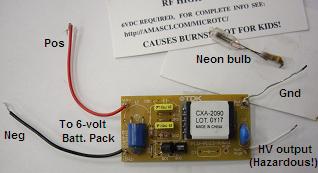
NEEDS A 6-VOLT AA BATTERY PACK. Try
270-409 batt holder from Radio Shack
Red wire goes to red, black to black. That RS holder has a tiny
on/off switch, nice.
YOUTUBE VIDEO TO COME! (Working on it right now, Mon 9/24 2012)
ITTY-BITTY CLASSIC TESLA COIL DEMO:
In a dimly-lit room, power up your
TC. Hold a tiny
neon bulb by both wires and place the glass part against the white HV
wire. Orange glow! Wireless lighting! Wave the tiny bulb near the square
transformer, and near the "hot" end of the circuit board. You can sense
the
invisible voltage in the space around the device. [If you
donated $200 to LET'S BUILD
A GODDAMN TESLA MUSEUM, look for the
small clear NE-2 neon bulb in the baggie with your device.]
MEDIUM-SIZE CLASSIC TC DEMO:
In a dimly-lit room, grip a standard
fluorescent tube[*] in your hand
and hold it a half-inch away from the white HV wire. It lights up dimly.
Now touch the metal pins of the tube to the HV wire and the tube lights up
quite brightly. But where is the complete circuit? Connect the HV wire
to one of the tube's pins and lay the lamp tube on a non-metal table.
You've made a gas discharge lamp run in "Single-electrode Tesla mode."
Touch the glass and watch the plasma respond.
[*]WARNING, don't use a good compact fluorescent spiral bulb, the HV can
burn out the electronics. Try it with a dead one.
CURRENTS THROUGH YOUR FLESH:
Run your TC, grip a coin or metal key
firmly in your
fingers, and touch it gently to the end of the white HV wire. Pull
slowly away, and you can draw a little purple arc between the coin
and the wire ...yet you feel nothing. The frequency is far too high to
trigger pain nerves (but it's too low to produce much "skin
effect.") Notice that the path for electric current goes RIGHT THROUGH
YOUR HAND.
ITTY BITTY PLASMA GLOBE:
Find one of those
neon
"Flicker-Flame(tm)" or a
Pink Flamingo Bulb with the green phosphor palm tree.
Also buy a white ceramic light bulb socket to fit the bulb. Screw in the
bulb, then touch the white HV wire to either of the socket connections.
It glows, and also will repond to your fingers. KEEP FINGERS FAR FROM THE
METAL BULB BASE, or perhaps wind many layers of vinyl insulation tape
along the edge of the bulb base to prevent direct contact by fingers.
PLASMA TORCH, MINI VERSION:
Bend the HV wire and the bare ground wire so the tips are about 1/8-in
apart. Turn
on the device, then push the wires together briefly. PLASMA ARC
FORMS!!! Little violet spark. It's terrifically hot, and heats the
wires to dangerous temp. (Runs the batt. down quickly too!)
Carefully use the arc to cut things.
You can slice through plastic bag, or thin solder, or through very fine
magnet wire. Melt tines off a plastic fork. It sets paper on fire!
Perform "Electric Discharge Machining" on a pickel or
various fruits. Electrosurgery on lunch meat. Try sculpting some beer foam.
WIRELESS LAMPS:
Sandwich a piece of alum. foil (or copper PCB)
between two 1/16" sheets of plexiglas or styrene. Wire the foil to the HV
terminal, and for safety, cover all the edge-slots with RTV silicone caulk
or epoxy. (Optional: connect the ground wire to actual ground, or to a
few
feet of scrap wire.) Power it up. Any neon or fluroescent tubes placed
on
the
insulated plate will respond to the high-volt e-field and light up. The
plastic keeps you from getting zapped-burned accidentally. Actually this
is identical to the
power supply for a "Plasma Mug"
VARIABLE PLASMA SWORD:
For this one you need a variable DC power
supply and a fluorescent tube. (Perhaps try using a cheap 6V wall
transformer hooked to a lamp
dimmer?) First connect the Tesla Coil HV terminal to one pin on one end
of
the fluorescent tube. Tape a thin (1/8") strip of metal foil along the
length of
the fluorescent tube, and attach the foil to the TC ground wire. Now
vary the power supply between zero and +6V. A glowing "plasma finger"
advances and retreats within the fluorescent tube. Vaguely resembles a
Star Wars lightsabre. Uses actual plasma. (Note: a hundred of these can
be computer-driven as a
large electronic
sculpture. See more hardware
details.)
CREATE SOME SEVERE RADIO INTERFERENCE:
No! Bad! If you want to misuse Tesla technology, first go watch a small
TC installation blowing up all the major
cities in Europe. It's enough to make you go sit in a hotel room for
the rest of your life, and stock up on pigeon feed.
-
High Voltage Hobbyists
have
huge Teslacoils
-
Remember, it's not how large your Teslacoils are, it's what you do with
them
-
Insecure high-volt experimenters always building larger Teslacoils.
-
Avoid Teslacoil envy, instead start small
-
It's NOT OK to touch your own teslacoils. You could get hurt that way.
Even worse is to touch somebody else's, when you don't know exactly how
dangerous they are.
- Umm... ummm... nope, can't come up with any others.
Quickmeme? Stupid bumper-stickers for TC fanatics?
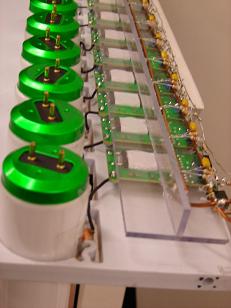
GIANT PLASMA-ART DEVICE: "Pond Machine III.I"
Bumbershoot Seattle, 2005
EVEN HIGHER VOLTS: mod the CXA2090 for higher power
On these 5-volt devices, if you crank the input higher than around
6Vdc, the coil will become warm. If you go much above 8V, an
internal arc will usually destroy it.
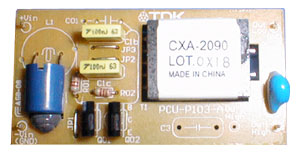
However, on the CXA2090 this problem can be cured. Inside the little
white transformer, the ground-wire for the HV secondary coil runs across
that coil.
Perhaps this is an intentionally bad design to keep the HV below a certain
voltage (where any accidental overload will trigger an arc and shut down
the output.) To fix it, carefully slice the white tape along the sides of
the xformer and remove the tape from the bottom side (circuit side, no
components.) Go slowly, since the
hair-thin ground wire runs across this tape. With the ground wire
exposed, very carefully slather it with RTV silicone caulk or with epoxy.
Don't break the wire!
Or, perhaps disconnect that wire so it no longer
extends across the coil, then sandpaper the varnish from the end of the
tiny wire and solder it to a different ground location. Put a bit of
silicone goo on the thin wire to keep it from breaking accidentally.
This will let your coil put out far more volts without destruction.
(Still the coil gets quite hot though, so don't run it too long.)
WARNING: CAUSES BURNS! NOT FOR CHILDREN!
This device is about as hazardous as a soldering iron.
While this thing can't shock you, it can easily burn holes
in your skin with its few-watts electric arc.
In other words, don't "zap" yourself on the
high-voltage section, or
you'll end up with a tiny black-charred pin-hole in your finger, a cloud
of burning-hair scent, and a small painful burn.
Also it can damage medical implants, computers, phones, etc.
See: "electrocautery"
|
|