![[Black conductor ring with a battery inserted in one spot, a resistor inserted in another spot]](/elect/poynt/fig1.gif)
|
| Fig. 1 A SIMPLE CIRCUIT A battery is connected to a resistor such as a light bulb. The battery converts its chemical fuel into waste products, and the resistor gets hot. |
|
|
|
|
IN A SIMPLE CIRCUIT,
|
|
|
|
|
|
|
|
|
|
|
|
|
|
SEE ALSO:
Poynting-flow diagrams are extremely rare in physics texts, and the
majority of physics instructors seem unaware that they exist. Perhaps the
reason is, that while still children, we were all taught that energy flows
inside the wires. These childhood science misconceptions are
extremely difficult to change. Our physics misconceptions frequently
remain unexamined, and often persist well into adulthood science and
engineering careers. For example, RP Feynman mentions the Poynting-flow
concept in "The Feynman Lectures," Chapter 27, and performs EM-field
energy flow analysis on capacitors and resistors. But then he doesn't
analyze 2-wire transmission lines, nor does he link all the components
together into a continuous system as with my figure 7 above. Worse, at
one point he angrily bad-mouths the whole concept, and insists that the
evidence shouldn't lead us to change our original viewpoint. Instead he
suggests that we continue to assume that the energy flows inside the
copper! This is Feynman?!! Counciling dishonesty rather than
harnessing an "alternate toolkit?" Amazing. (And ...doesn't he know
that the speed of light within solid copper, the speed which causes Skin
Effect phenomena, is down in the meters per second range? How then can
electrical energy cross the circuit so quickly?)
If the common misconception that "energy flows inside wires" has had such
a deleterious effect on an honest free-thinker like Feynman, imagine the
trouble a more conventional mind would have with it. No joke, I see this
as quite a frightening issue.
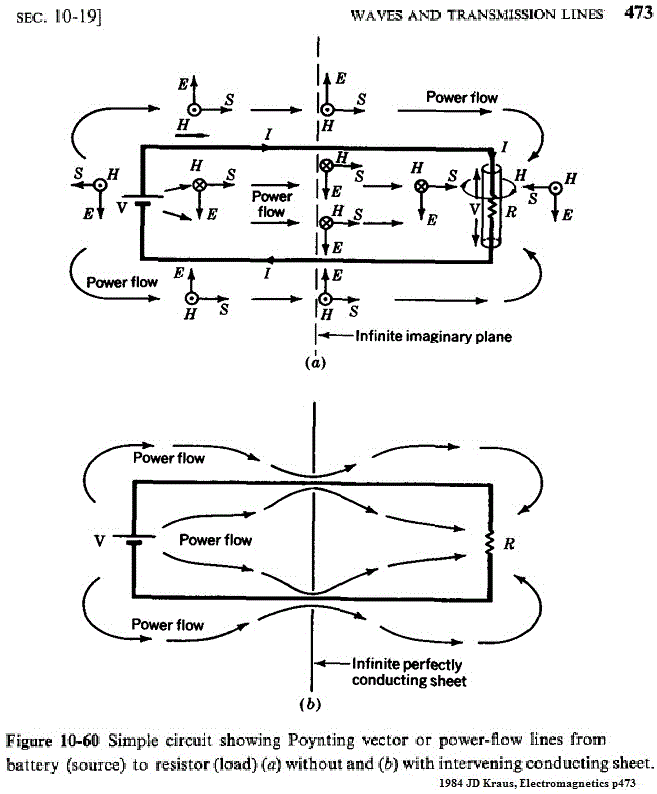
Here's another version of my figure 7:
page 417, Fig 10-19, found in:This one above is interesting, because it shows one place where poynting vector energy flow is a crucial idea: Antenna Design! Kraus' Electromagnetics is essentially an antenna design book aimed at physics students. (But note that Kraus makes an important point: the source in the above diagrams ...is a battery! The propagating EM flow has 0Hz frequency.)
|
 .
.
![[Same black ring w/battery and resistor, but with arrows depicting the circular charge-flow inside the ring.]](/elect/poynt/fig2.gif)
![[Same black ring with arrows, but this time with bullseyes of magnetic field distributed around the ring (the ring passes through the center of each bullseye pattern]](/elect/poynt/fig3.gif)
![[Oblique 3-dimensional view of figure 3]](/elect/poynt/voltaged.gif)
![[Battery and resistor removed from the black ring, leaving two gaps. One remaining piece of the ring has plus signs all over it. The other piece has minus signs]](/elect/poynt/fig4.gif)
![[The two ring-pieces above are now connected with e-field flux lines, as if the two pieces were oppositely-charged capacitor plates]](/elect/poynt/fig5.gif)
![[The two ring-pieces above are now connected with e-field flux lines, as if the two pieces were oppositely-charged capacitor plates]](/elect/poynt/voltagee.gif)
![[Two earlier figures combined: the bullseyes of magnetic field and
the e-field flux lines are drawn surrounding the black conductor
ring.]](/elect/poynt/fig6.gif)
![[3D oblique version of fig 6]](/elect/poynt/voltagef.gif)
![[A new field surrounds the black ring. The field lines spew out of the battery, flow in the space around the ring and parallel to the two halves of the ring, then dive into the resistor.]](/elect/poynt/fig7.gif)
![[The energy-flow field as in the previous diagram, but with the flux-lines of e-field lightly sketched in]](/elect/poynt/fig8.gif)
![[Again the energy-flow field, but with the bullseyes of magnetic field lightly sketched in]](/elect/poynt/fig9.gif)
![[The black ring conductor with ALL the flow lines and field lines. It looks like an obscure mess.]](/elect/poynt/figa.gif)